

|
Getting your Trinity Audio player ready...
|
Cities need water for their inhabitants and today this is usually pumped by nondescript water pumping stations run by electricity and modern technology. Go back 165 years and imagine how these pumping stations used to look? How did they run? These questions and many others are answered by the Museum of Steam Technology in Hamilton.

Last month I was in Hamilton for a short weekend trip. One of the things I did on the first day was visit the Museum of Steam Technology which is an underrated gem. Having worked for 5 years in Thermal Power Plants in India in which steam plays a huge role, I was very curious to see what this museum contained. In the plants I worked at, steam is the driver of the massive steam turbines which produce 600MW of power which is enough to power all households in Hamilton and that’s only one turbine. We had four of those.
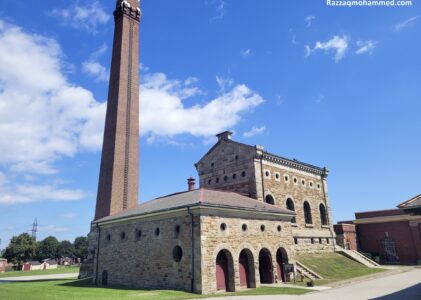
I reached the Museum, which is also a National Historic Site of Canada, around 1 PM and was the only one in at that time. The Museum is housed in three structures built in Victorian style. The first is the one where the massive boilers were kept. Today it houses the reception. The second structure houses the steam cylinders, pumps and other auxiliaries. The third structure is the chimney to discharge the flue gas from the furnaces. There was a lady manning the reception who issued my ticket and asked me to wait for the next scheduled tour start time which was in 15 mins. I strolled around the reception area which had some pictures and exhibits displayed.

Soon the tour started with just myself as there was no other person. The lady, I forget her name now, was pretty good with her explanation. She asked me a bunch of logical questions which made me arrive at the purpose of the building, instead of her just telling me everything. This line of explanation forces the listener to think which is a very effective way of making someone understand.
Built in the Victorian style 165 years ago, its largely intact which is rare for a structure like this. Back in 1854, a city committee announced a public competition to design a public water system suitable for 40,000 people which was about 4 times the population of the city. The prize money was 100 Pounds. A design by American engineer Samuel McElroy won the competition but ultimately the City decided to not go with him and instead choose the person who was reviewing the submissions, Thomas Keefer to be the Chief Engineer to build the water system.

The reason its called the Museum of Steam Technology is because the main driver of the process is steam. Here’s how it worked. Coal was fed into the boilers which heated up water and turned it into steam. This steam drove the shafts of the rotative beam engine which in turn did the work of pumping water from one location (Lake Ontario) to another (a reservoir on the Niagara Escarpment). There used to be two engines, each producing 100 HP which is roughly 70 kW, weighing 90 ton. Only one of them still operates but with an electric motor now. In comparison, the plant I used to work at back in India, one steam turbine at 600 MW was equal to 8000 of these engines.

The lady was excellent in her explanation of the way it worked and the whole tour was very insightful. Of course I am no stranger to steam cycles so it was relatively easier for me to understand. The total tour was more than an hour long with the lady graciously extending the time since I was very enthusiastic. I thanked her profusely before leaving to continue my day.

Overall it was an amazing to look at a snapshot in time of steam technology of the 1850s. The plant that I worked at was based on Rankine Cycle and this pumping station was based on a Woolf compound cycle. Of course, the uses of those two stations were different. The purposes were different too, one generated electricity, the other moved water. After the visit, outside I could spot the current pumping station building which is nearby and couldn’t help but notice how nondescript it was. It was a far cry from the museum’s building, with its Victorian brickwork and ornate columns.
Quick Details
Address: Hamilton Museum of Steam & Technology National Historic Site
900 Woodward Ave, Hamilton, ON L8H 7N2
Ticket: $10.50
Hours: Open year round
Tuesday – Sunday from 12:00 pm to 4:00 pm