
|
Getting your Trinity Audio player ready...
|
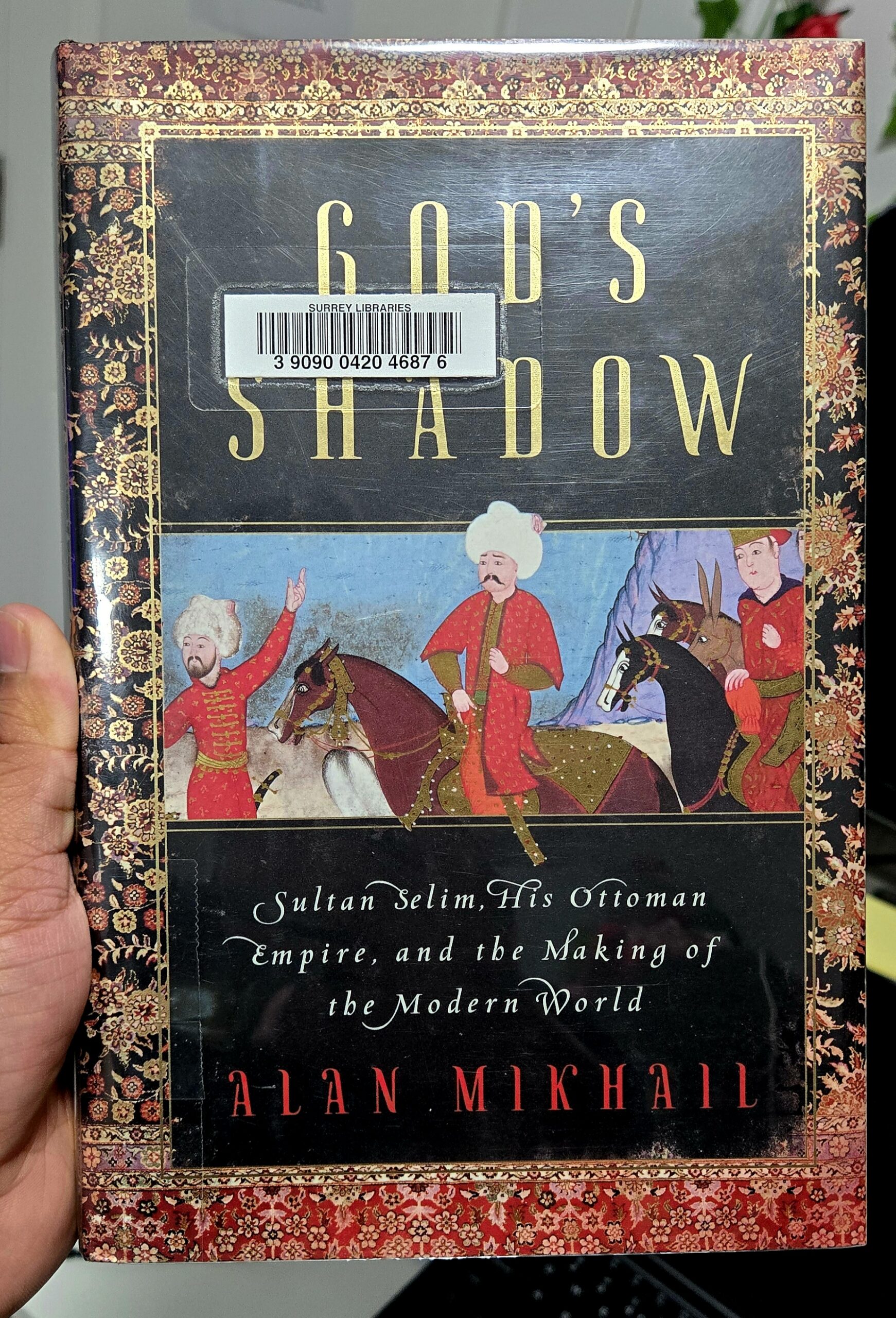
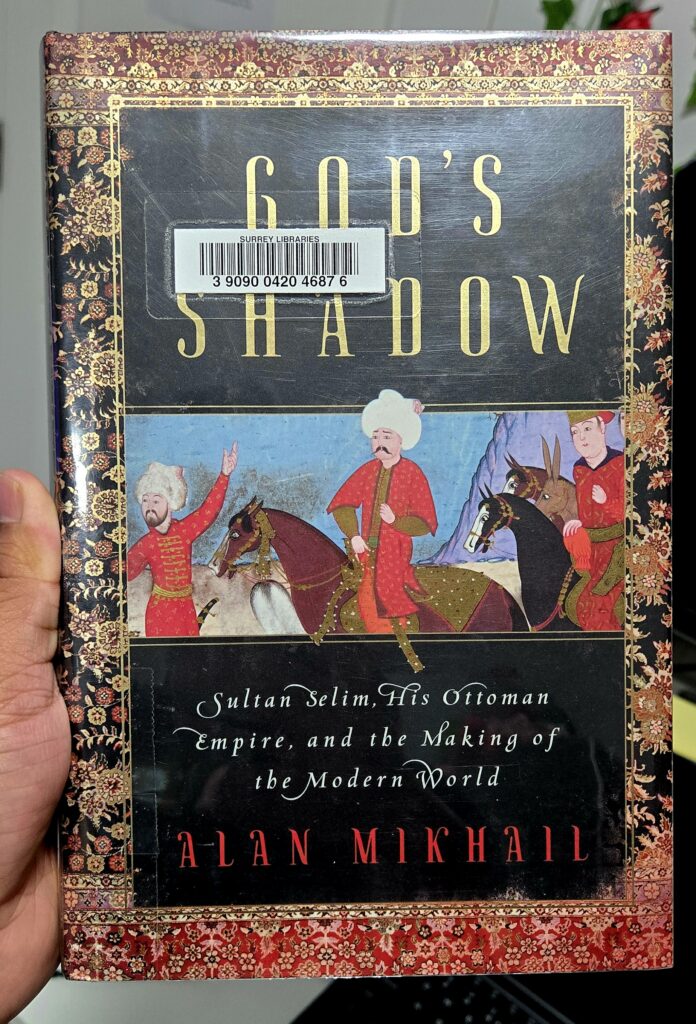
1. Name: God’s Shadow : Sultan Selim, His Ottoman Empire, and the Making of the Modern World.
2. Author: Alan Mikhail
3. Genre: Non Fiction/History
4. Book Post No. : 78
In the early 16th century the mere rumor of spotting Ottoman ships off the coast of an enemy city would send shivers down other empires. During this time and at several other points in history, the Ottoman Empire was arguably the world’s most powerful empire, distinguished by its vast territorial extent, military might, economic strength, and extraordinary cultural achievement. One person most responsible for this was Sultan Selim who ruled from 1512 to 1520. This book traces his life, his conquests, the prevailing conditions in Europe and the New World before and during his reign and how the equations between Muslims and Christians played out from the world-changing events of the 1490s.
This book can be broadly classified into three main parts on the basis of the central theme and not the order of chapters. The first one is from Selim’s birth to him becoming the king, the second part is the fascinating account of the Christian and Muslim dynamics which laid the groundwork for much of the world events later and finally the third part which deals with Selim’s reign from 1512 to 1520 when he died.
For me the most fascinating part of the book was definitely the one which talks about the motives of the Spanish empire seeking new trade routes to the east, particularly to India. When Christopher Columbus set out from a port in Huelva, on his first voyage, one of his goals for this voyage was to try to meet a grand king in the east who was sympathetic to Christianity (this was the belief back then based on a few incidents which are too complicated to mention here). His aim was to forge a Spanish alliance with him to retake Jerusalem (which was under Mamluk control then) and to wipe out the Muslim threat from the world forever. The other goal of course was to bypass the trade monopolies of the Ottomans and Mamluks. Alan, the author, takes multiple chapters elaborating these dynamics and argues that Islam in general and the Ottomans in particular have played a huge part, more than what is acknowledged by the west, in shaping European history and consequently, world history
Much of the Ottoman Empire’s power and influence was the result of one man’s extraordinary push to expand his empire. During his reign Selim waged war against his eastern neighbors the Safavids, who were Shia. This was a precursor to the still ongoing tussle between Sunnis and Shias in West Asia. Perhaps the most ambitious of Selim’s conquests was his conquest of the Mamluk Empire which was based in Egypt, the Levant and the Hejaz. Mamluk Empire, which was Sunni, had some of the most important Islamic cities in it like Cairo, which was at that time one of the most prestigious cities in the world, Aleppo, Mosul, Mecca, Medina and others. After adding the territories of the Mamluks, for the first time, the Ottoman Empire had a Muslim majority population. Till that time, the Ottoman Empire had largely Christian subjects who lived openly and maintained their religious communities. Selim finally met his end at the age of 50 due to an illness when he was planning a conquest of Morocco to get closer to Europe. He spent most of his years away from his capital, planning campaigns and warring but he also found the time to lead a reformation of the Islamic Court System.
Throughout his life Selim had to fight for his place. His father, Bayezid, son of Mehmed II, the conqueror of Constantinople, favored one of his other sons to succeed him and therefore gave Selim the governorship of a city far from Istanbul. Selim accepted what was given to him and turned it to his advantage. He spent his time at Trabzon fighting the Safavids and also making important connections and generally strengthening his network which included the elite Janissary troops. Selim then defeated and killed his rival brothers and forced his father to abdicate while still alive, the only Ottoman prince to do so till that time.
Overall, the book ebbs and flows much like the waxing and waning of Selim’s fortunes. It starts off slow, with Selim making an impact only much later in the book. The indirect role of Islam and Muslims in triggering of the age of exploration was an eye-opener for me as mentally I always separated the histories of these two religions from the end of the last of the crusades. The chapters on Selim’s conquest of the Mamluks are the best part of the book with descriptions of the preparation, strategies, troop movements and logistics. This is an excellent read offering different viewpoints on many of the things we have heard often and learn in school.
Other History themed Books (related to countries) that I have read and reviewed:
1. A Short History of Malaysia : Click here
2. A History of Canada in Ten Maps Click here
3. A Brief History of Spain Click here
4. The Incredible history of India’s Geography Click Here
5. Mecca: The Sacred City Click Here
6. A Concise History of Canada’s First Nations Click Here
7. The Ornament of the World Click Here
8. The Last Days of the Incas Click Here